
K-Drum Black Belt — Drum Magnetic Separator for Heavy Ferrous Contamination
When ferrous contamination loads exceed what inline magnetic separators can manage in a single stage — heavy grinding sludge, large chip volumes from gear cutting and broaching, or the combined ferrous output of multiple machines on a central coolant circuit — the K-Drum Black Belt drum magnetic separator provides the continuous, high-capacity ferrous separation that handles these loads automatically and indefinitely.
The K-Drum uses high-intensity rare-earth permanent magnets that are 10 times more powerful than the conventional ferrite magnets used in standard industrial drum magnetic separators. This extraordinary magnetic force captures fine ferrous particles — including sub-20 micron swarf — that conventional drum separators discharge with the clean coolant. The Black Belt continuous discharge mechanism ensures that captured ferrous material is continuously transported out of the collection area without manual intervention, maintaining separation performance regardless of contamination load.
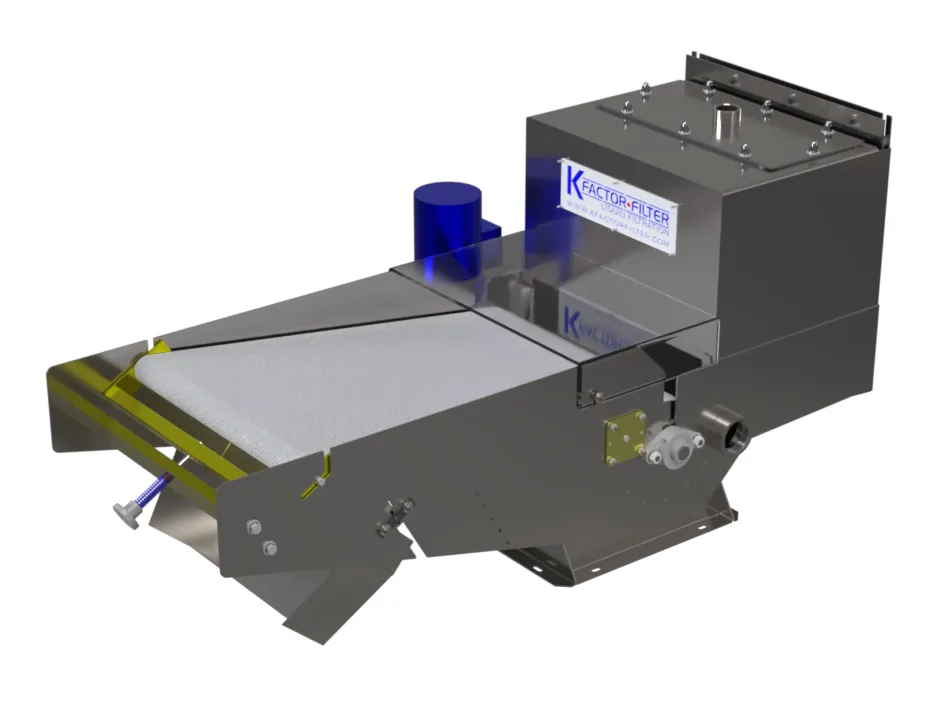
K-Drum — how it works
- Coolant or process fluid enters the K-Drum housing and flows over or around the magnetic drum. The rare-earth magnetic field — 10× the strength of conventional ferrite drums — attracts ferrous particles to the drum surface as the fluid passes.
- Captured ferrous particles adhere to the rotating drum surface and are carried out of the fluid stream as the drum rotates. The strong rare-earth field holds particles securely against the drum surface even in high-flow conditions where weaker conventional drums would release particles back into the fluid.
- The Black Belt conveyor continuously removes accumulated ferrous cake from the drum surface. The Black Belt system transports the captured ferrous material — including grinding swarf, metallic chips, and fine ferrous fines — to the collection bin continuously, without stopping the separation cycle and without operator intervention.
- Clean fluid exits the housing at a ferrous particle concentration significantly lower than the inlet — returning to the coolant tank, sump, or process water circuit for reuse. The separation continues indefinitely at this performance level.
K-Drum — gallery
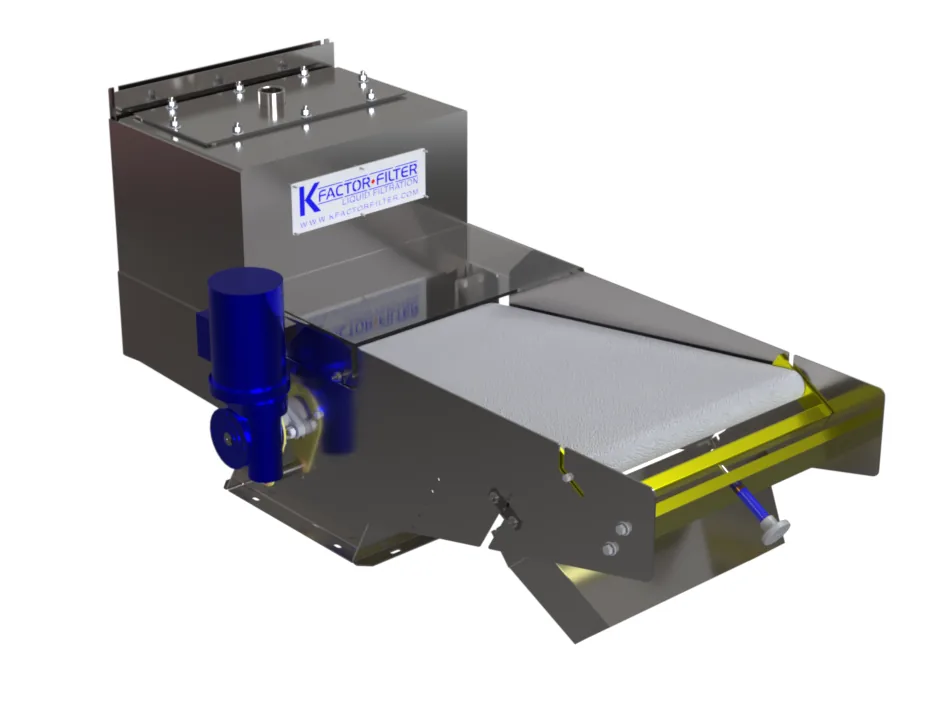
Drum & Black Belt assembly
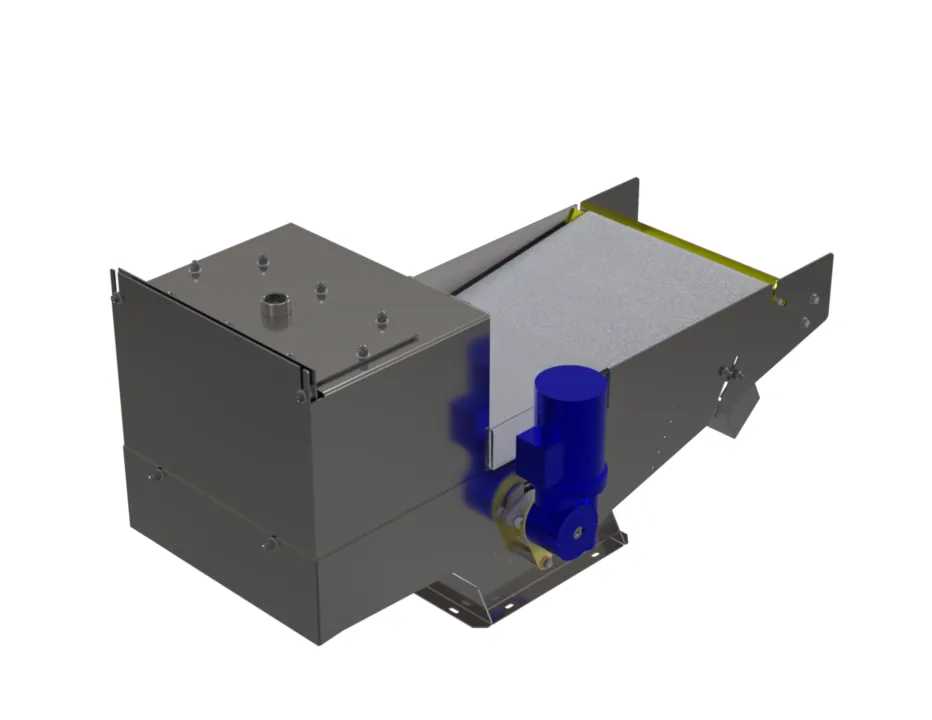
Side profile
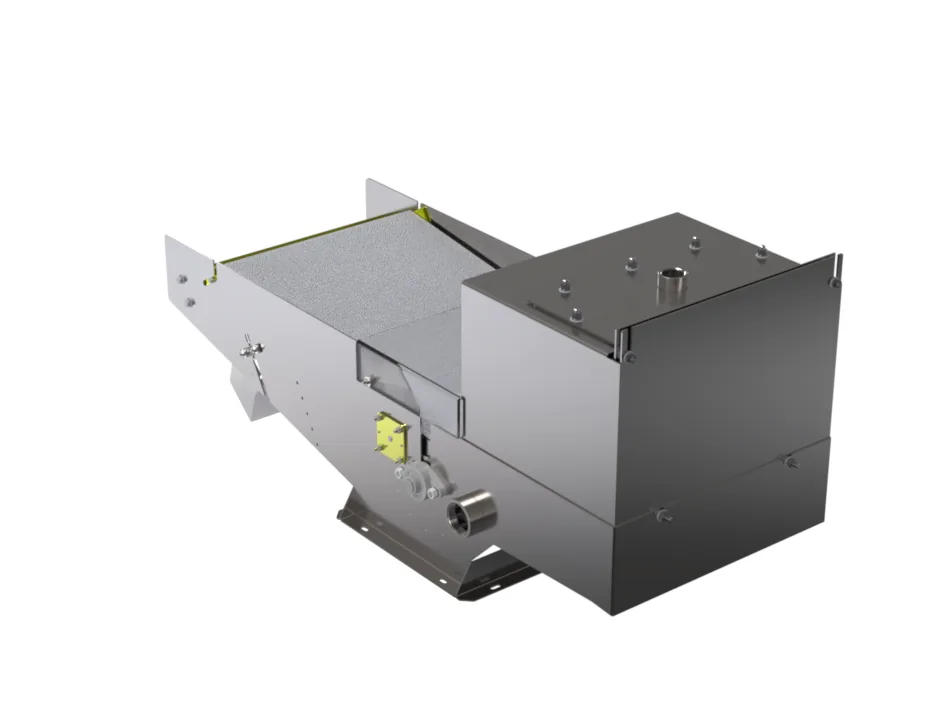
Discharge configuration
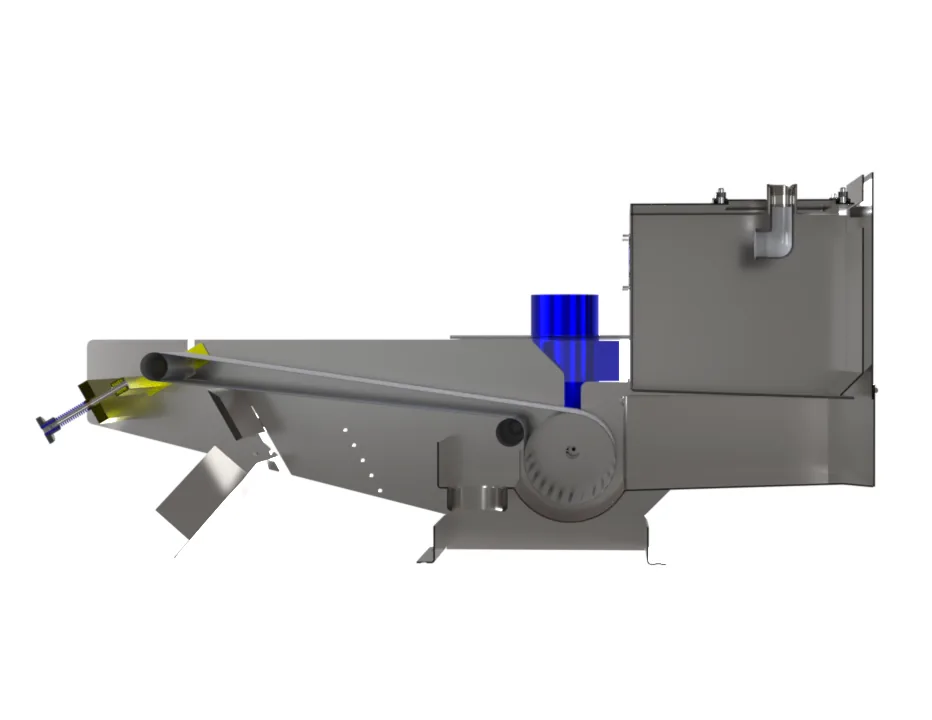
Detail view
K-Drum specifications
Magnetic system
- Magnet type
- High-intensity rare-earth permanent magnets
- Magnetic strength
- 10× more powerful than conventional ferrite drum magnets
- Field penetration
- Deep magnetic field captures fine sub-20 micron particles that standard drums miss
- Magnet permanence
- Permanent — no power required for magnetic field; no degradation over time
Discharge system
- Black Belt conveyor
- Continuous automatic ferrous cake discharge — no manual intervention
- Collection
- Ferrous cake discharged to collection bin — dry or near-dry for simplified waste management
- Operation
- Continuous — no cycle interruptions for cleaning or cake removal
- Integration
- Inline addition to PAC-MAG system; also used as standalone primary drum separator
Performance benefits — column 1
- Media consumption
- 50–80% reduction in paper bed or gravity media filter consumption when magnetic separation removes ferrous particles upstream — the majority of media loading mass in ferrous machining
- Coolant life
- 3–5x extension when ferrous particles (which catalyse coolant degradation by introducing reactive metal surfaces) are continuously removed
Performance benefits — column 2
- Tool and wheel life
- 20–40% improvement in grinding wheel and cutting tool life when sub-25 micron ferrous swarf is removed from the coolant circuit — reducing abrasive cutting edge wear
- Surface finish quality
- Measurable improvement in Ra values and dimensional consistency when coolant is free of hard ferrous particles that act as additional abrasives between workpiece and tool
Primary applications — K-Drum Black Belt
Grinding sludge separation
Surface grinding, cylindrical grinding, and centreless grinding generate the highest ferrous contamination loads of any machining operation — fine abrasive swarf at concentration levels that load conventional drum separators in minutes. The K-Drum's rare-earth magnetic field captures grinding swarf more completely than conventional ferrite drum separators, and the Black Belt continuous discharge prevents cake buildup that would otherwise require manual cleaning cycles.
Facilities running heavy stock removal grinding operations report that the K-Drum maintains consistent coolant clarity through full production shifts — something conventional drum separators cannot achieve without frequent manual intervention when sludge loading is high. The near-dry ferrous cake discharged by the Black Belt system simplifies waste management: grinding swarf has significant scrap metal recycling value when delivered dry rather than wet.
Gear cutting — hobbing, broaching, shaping
Gear cutting operations produce large volumes of metallic chips in a relatively small coolant volume — concentrating ferrous contamination rapidly. Hobbing and broaching in particular generate chip morphologies (long curling chips mixed with fine powder) that challenge conventional drum separators by creating mat-like chip accumulations that block the scraper and require manual clearing.
The K-Drum's Black Belt continuous discharge mechanism handles gear cutting chip morphologies without intervention — the Black Belt's positive mechanical drive removes chips continuously regardless of their shape or volume. The rare-earth magnetic field ensures that fine ferrous powder generated alongside the larger chips is also captured — preventing the fine powder from circulating in the coolant and loading downstream media filters.
Purge fluid recovery — PAC-MAG circuit
In a PAC-MAG + K-Drum circuit, the K-Drum's primary role is fluid recovery: receiving the PAC-MAG purge stream, extracting the concentrated ferrous solids using the rare-earth magnetic field, and returning the clean fluid to the process. This purge recovery function makes the K-Drum the critical component in a zero liquid discharge magnetic separation circuit — ensuring that no process fluid is lost to waste during the magnetic separation purge cycle.
Service Locations — K-Drum Black Belt
Still running media filters that consume rolls every few hours in grinding?
K Factor's 30-day free trial is available for magnetic separation systems. We assess your ferrous particle loading, fluid type, flow rate, and downstream filtration system. We commission the appropriate GT-MAG, PAC-MAG, or K-MAG inline in your circuit. You run it for 30 days and measure the reduction in media consumption, coolant clarity, and tool life. If the results don't justify the investment, return the system. No invoice. No commitment.
Available to qualifying facilities in the United States, Canada, UAE, Saudi Arabia, and other markets.